
Shopify Review for Service Businesses: Capabilities, Costs, and Tradeoffs
Quick Summary: Shopify can host a service business, but it forces you to build bookings, deposits, and subscriptions on top of a product-first platform using paid apps. Real monthly costs run $80 to $150 once you add a booking tool, email marketing, and a theme on top of the $39 Basic plan. The bigger issue is SEO: Shopify's blog and URL structure are rigid, which hurts the city and service pages that local service businesses depend on. Shopify makes sense if you sell products alongside services or need a site up this week, but a custom build usually wins when local lead generation drives your revenue.
If you run a service business and most Shopify reviews talk to product sellers, here is the straight answer. Shopify can host a service site, but it is a product platform in a service-business costume, and that shows up in bookings, costs, and SEO. This Shopify review for service businesses covers the real totals, the tradeoffs, and when a custom build fits better, drawing on our work in local SEO and web development for service owners.
What Shopify Actually Gives a Service Business
Any honest Shopify review for service businesses starts with a simple fact: Shopify was built to sell products, not hours. You can still make it work, but you will build service sales from product parts. Here is what you get out of the box, and what needs help.

Service listings, deposits, and subscriptions
Services become "products," so customers can buy a cleaning, consult, or class just like a t-shirt. Deposits need a workaround: many owners sell a partial-payment product or use an app that takes a deposit up front and charges the rest later. Subscriptions for maintenance plans or memberships work well through native subscriptions.
Booking and appointments require an app
Shopify has no built-in calendar. To let customers pick a time, you install a booking app such as an appointment tool or a scheduler that syncs with Google Calendar and sends reminders, as Shopify's own roundup explains. Most good apps cost extra each month, and setup varies. Budget for that when comparing platforms.
What a Shopify Service Site Really Costs Each Month
Plan tiers for service-only shops
Shopify's US plans run Basic at $39, Grow at $105, and Advanced at $399 per month, with Plus from $2,300. Yearly billing drops Basic to $29 and Grow to $79. Most service shops fit Basic, since you're selling bookings rather than heavy order volume. Higher tiers mainly buy better reporting and lower card fees, which matter little if you take payment off-site.
Add-ons quietly add up
The sticker price is only the start. A booking app, email marketing, and a premium theme often cost $30 to $100 extra each month, and transaction fees still apply when you use outside checkout tools. Budget realistically at $80 to $150 monthly all-in for a lean service setup. If that spreadsheet keeps growing, a custom build may cost less over a few years.
The Tradeoffs Service Owners Should Know

Local SEO and content flexibility
Shopify's blog is basic. You get one content type, limited category structure, and thin control over page titles and schema. That matters because local rankings depend on dedicated pages for each service and each city you serve. Shopify owners on its community forum report that SEO control is workable but less detailed than a custom build offers for local service pages. URL structure is another snag: most service pages sit under a forced folder path you can't remove. You can still win local search with strong content and citations, as Shopify's own local SEO guidance shows, but expect workarounds. For deeper ranking factors, see our breakdown of local SEO ranking factors.
Is Shopify Worth It for a Service Business?
It depends on how much you sell. Shopify shines when bookings are tied to products, but its ecommerce core adds cost and limits for pure service work. Budget $80 to $150 monthly all-in.
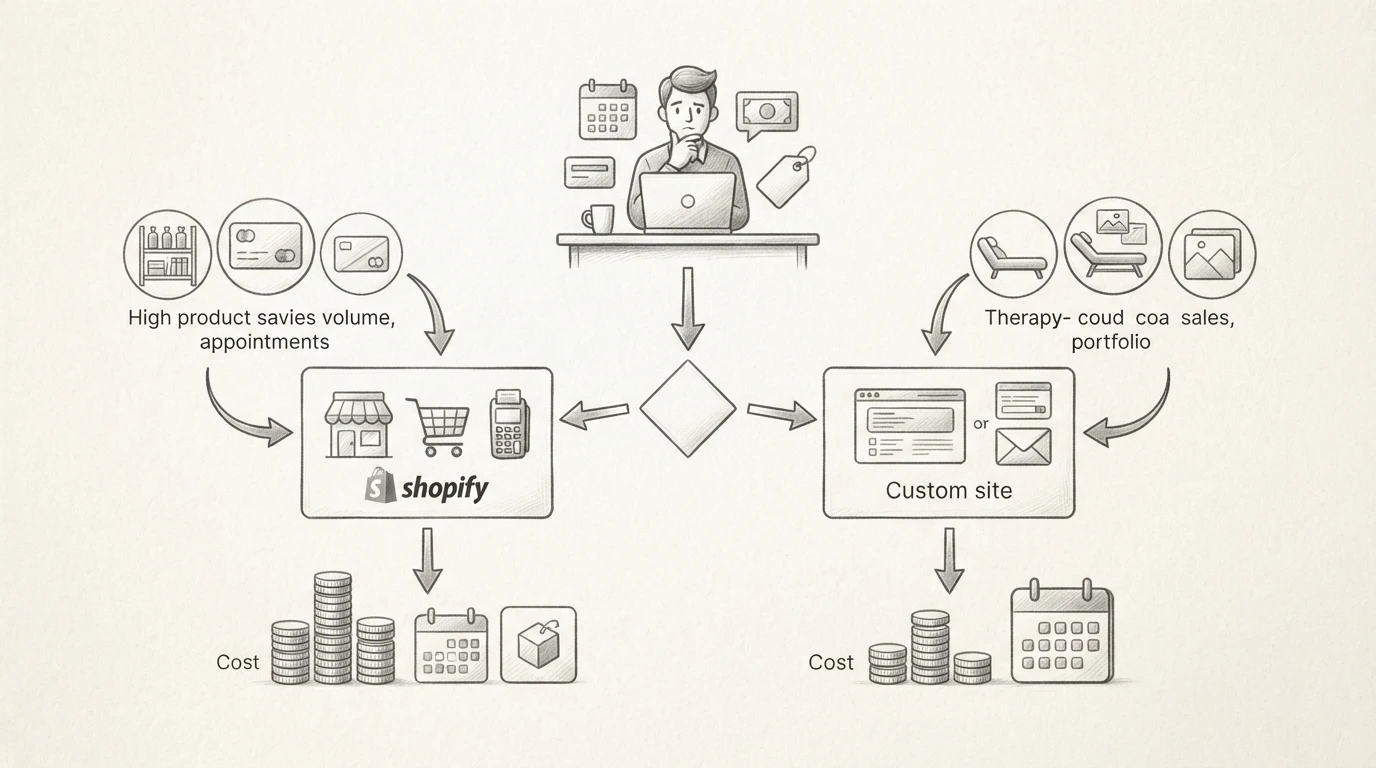
Pick Shopify if...
You sell products alongside services, want built-in payments and booking apps, and need a live site this week. Shopify handles payments, checkout, and customer management well, even for service sellers.
Pick a custom site if...
Local SEO and lead generation drive your revenue. A custom build gives full design control, no app fees, and you own every asset, which matters for ranking in local search.
Pros and cons at a glance
Pros: fast setup, secure checkout, booking apps, low maintenance. Cons: monthly app costs, blog and SEO limits, ecommerce features you may never use. If SEO drives your pipeline, a responsive custom build often wins long term.
If Shopify's tradeoffs feel heavier than the benefits, a custom site may fit better. Harrigan Creative builds service websites designed to book jobs and grow revenue. Reach out for a straightforward assessment.
Frequently Asked Questions
Q1: Is Shopify suitable for a service business website?
Yes, with limits. It handles payments, bookings via apps, and fast setup, but you'll pay $80-$150 monthly all-in and sacrifice local SEO control that a custom build provides.
Q2: Do I need a booking app for appointments on Shopify?
Yes. Shopify has no built-in calendar, so you'll install a third-party booking app that syncs with Google Calendar. Expect extra monthly fees on top of your plan.
Q3: Can I take deposits for services on Shopify?
Not natively. Most owners sell a partial-payment product or use an app that collects a deposit up front and bills the balance later.
Q4: What's the cheapest way to run services on Shopify?
Stick to the Basic plan, use a free theme, and choose one lean booking app to stay near the low end of your monthly budget.
Conclusion
Shopify works for service businesses that also sell products, but expect $80-$150 monthly and limits on bookings, deposits, and local SEO. If lead generation drives your revenue, weigh those tradeoffs against a custom build before you commit.